
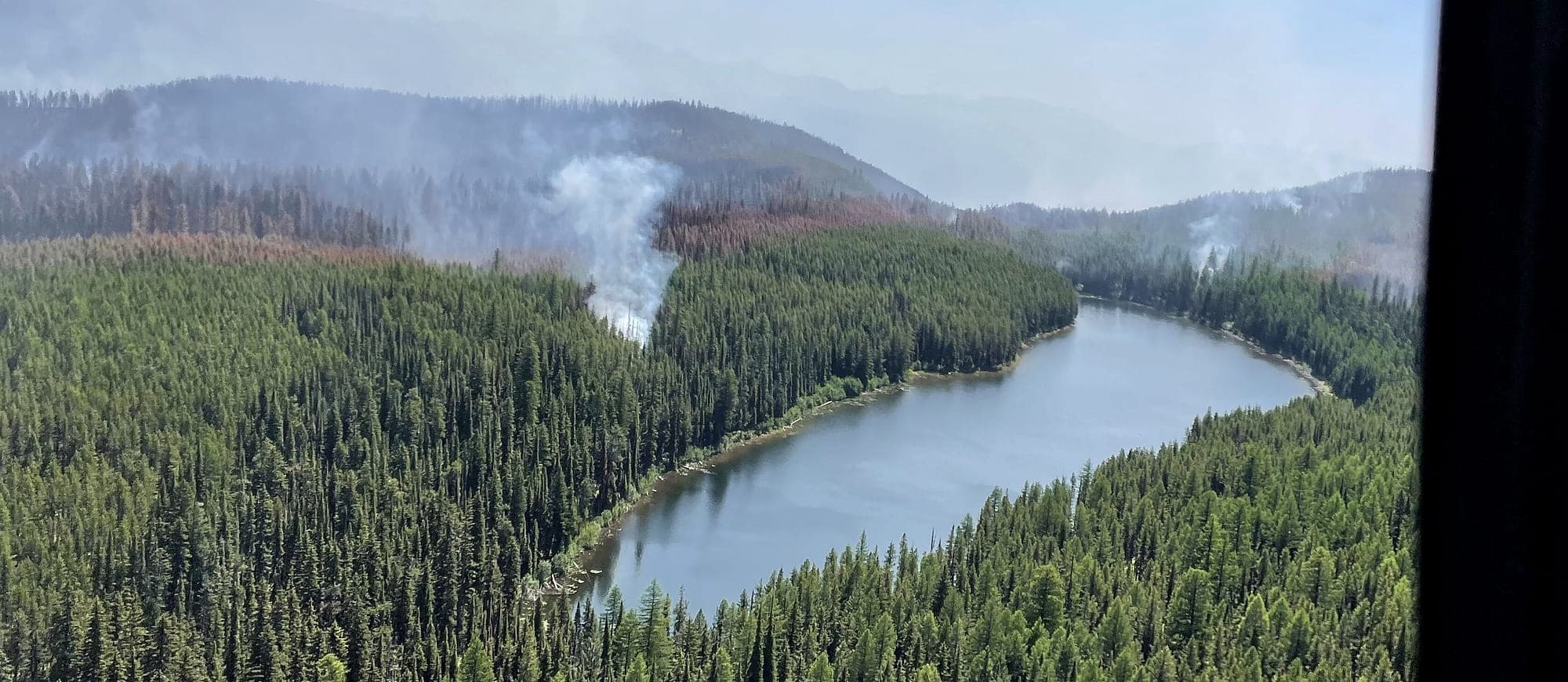
Work outward, not inward
The return is highest right next to the building and falls off with distance. Inside about five feet of the walls, the goal is that nothing there will hold a flame. No bark mulch against the siding, no woodpile under the eaves, no juniper against the foundation, nothing stored under the deck. From five to thirty feet, you're breaking up continuous fuel so a fire on the ground can't climb into anything.
From thirty feet to a hundred and beyond, depending on slope and aspect, it becomes forestry. Separating crowns so fire can't run through them, taking out the low branches and small understory trees that let a ground fire climb, and cutting down the dead material on the ground. Above a house on a steep south slope that zone needs to run a lot further, because fire moves uphill fast.
What this doesn't mean
It doesn't mean clearing your property. The objection I hear most is that people bought forested land in order to live in trees, and they picture defensible space as taking the trees away. Done right it's closer to the opposite. The point is to keep a forest that's healthier and much more likely to still be there after a fire, not to end up with a lawn and a house on it.
A good treatment usually looks better than what it replaced. Fewer, bigger, healthier trees with room between them. An understory you can walk through. Views that fifty years of ingrowth had closed off. The stands that burn catastrophically are dense thickets of small stems, not open groves of big trees.
The part most assessments skip
Vegetation is only half of it. Embers get into buildings through attic and foundation vents, pile up in roof valleys and gutters, catch in the gap between deck boards, and work their way under wood shake roofing. A property with immaculate defensible space and unscreened vents is still exposed.
A useful assessment covers both and puts them in order: what to do this month, what to do this year, what can wait. Wildfire work is easy to spend unlimited money on, and the difference between a good plan and a bad one is mostly sequence.
Money that exists to help pay for this
There's real public funding for wildfire risk reduction on private land in Montana. Federal hazardous fuels and Community Wildfire Defense money runs through the state, and some local programs around Missoula reimburse a solid share of the labor cost on qualifying work.
Eligibility and deadlines vary by program and by where you sit, and the applications generally want exactly the documentation this work produces anyway: a written prescription, mapped units, defined acreage. Worth finding out what you qualify for before you pay for anything out of pocket.
Questions people ask
A hundred feet is the usual starting number on flat ground, and further where the ground climbs away from the house, since fire travels uphill much faster than across the level. The five feet right around the structure matters more than any of it and is where most people should start. Slope, aspect, prevailing wind, how thick the timber already is, and how far you are from a fire department all move the number.
It can, and Montana law now lets insurers offer premium reductions for verified wildfire mitigation and resilient construction. What carriers actually accept varies a lot between companies, and most want evidence, not a description. Photos, a written scope, and confirmation the work got done. If lowering a premium or fixing a non-renewal is the goal, ask your agent exactly what their underwriter needs before the work starts. Retrofitting the paperwork afterward is much harder.
For non-commercial thinning around a house, generally no. If the work takes out enough merchantable volume to sell, a forest practices notification is required, and the Streamside Management Zone rules apply near water at any scale. Subdivision covenants, homeowners association rules and conservation easements often add their own conditions, and those catch people out more often than state law does.
The range is wide, because cost is driven almost entirely by how much material has to move and what happens to it. Widely spaced big trees needing limbs raised is cheap. A dense thicket of small stems that has to be cut, piled and burned or chipped is many times that. Steep ground, bad access and nowhere to put slash all push it up. Getting the prescription right first usually saves more than shopping the price does, because it determines how much work there actually is.
An assessment says what needs doing and in what order, and produces the written prescription and map that a contractor bids against and that grant programs ask for. The work itself gets done by crews with saws, chippers and masticators. I do the first and don't own equipment for the second, which means I have no reason to specify more work than your property needs. I can recommend contractors and inspect their work against the prescription.
Yes. What decides whether a structure survives is mostly the structure itself and the ground right around it, and that's entirely yours to control. Neighborhood-scale work is better still, and it's what most cost-share programs are built to encourage, so it's worth asking around. But the value of your own hundred feet doesn't depend on anybody else's decision.